How wholesale electricity is bought, sold, and priced — from deregulation to real-time market clearing. The framework every utility professional needs to understand.
For most of the 20th century, electric utilities were vertically integrated regulated monopolies — owning generation, transmission, and distribution. A series of federal policy changes opened the door to competitive wholesale markets.
Under the vertically integrated model, a single utility owned everything from the power plant to the meter. Rates were set by regulators to cover costs plus a reasonable return. Wholesale power trading, where it existed, was bilateral — negotiated directly between utilities.
This model worked well when economies of scale kept driving costs down. But by the 1970s, nuclear cost overruns, environmental regulation, and technology shifts began pushing costs up — creating pressure for a new approach.
Nuclear and coal plant costs escalated. By the 1980s, many utilities had overcapacity and ratepayers were unhappy.
Policymakers believed competitive markets — like those transforming telecommunications — could lower electricity costs through market efficiency.
Opened the door to non-utility generators
Required integrated resource planning, renewable support
Open access transmission, led to ISOs
Promoted RTOs, competitive wholesale markets
Renewable tax credits, efficiency standards
Federal Energy Regulatory Commission — regulates interstate wholesale electricity sales and transmission. Approves RTO/ISO tariffs, market rules, and reliability standards. Sets the rules for competitive markets.
North American Electric Reliability Corporation — develops and enforces mandatory reliability standards for the bulk power system. Designated by FERC as the Electric Reliability Organization (ERO) in 2006.
Public Utility Commissions regulate retail utilities and distribution. Each state determines its own approach to retail competition, rate design, and resource planning. The result is a patchwork of regulatory frameworks.
Next: How is the physical grid organized to support these market structures?
The North American bulk power system is divided into three major interconnections, each operating as a synchronized AC network. Within these interconnections, regional organizations manage reliability and markets.
The largest, covering everything east of the Rockies (except Texas). Includes PJM, MISO, SPP, NYISO, ISO-NE, and the Southeast. All generators synchronized at 60 Hz.
Covers the western U.S. and parts of Canada/Mexico. Managed by WECC. Includes CAISO and a patchwork of balancing authorities. Connected to the Eastern via limited DC ties.
Operates its own interconnection, largely avoiding federal jurisdiction. Managed by ERCOT. Connected to the Eastern by limited DC ties. Serves about 26 million customers.
NERC oversees six Regional Entities (EROs) that monitor compliance with reliability standards across North America.
Approximately two-thirds of U.S. electricity consumers are served within organized RTO/ISO wholesale markets.
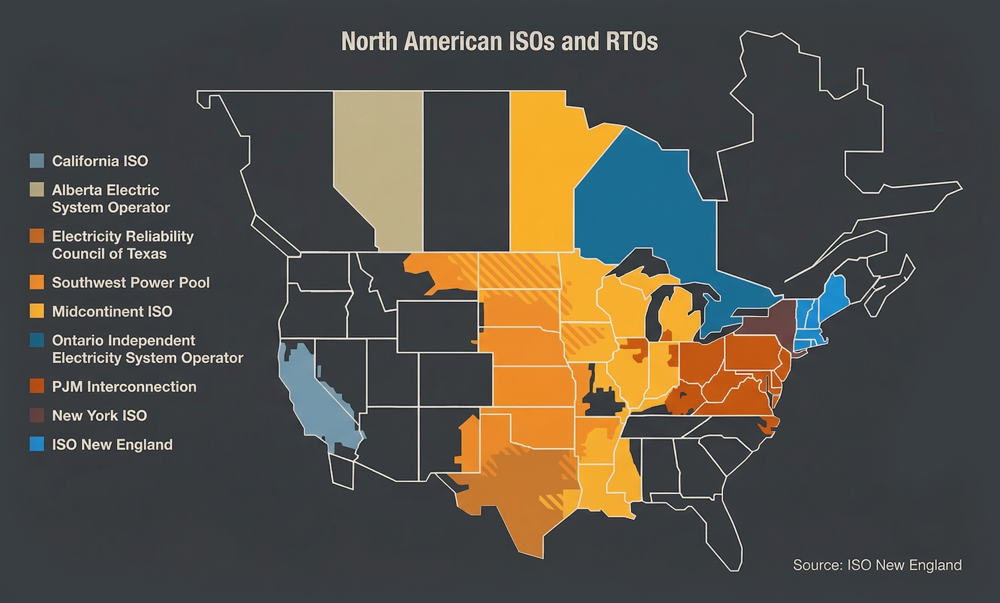
| NERC Region | Coverage Area | Key RTOs/ISOs |
|---|---|---|
| NPCC | Northeast U.S. & Canada | NYISO, ISO-NE |
| RF | Mid-Atlantic, Great Lakes | PJM |
| SERC | Southeast U.S. | No organized market (bilateral) |
| MRO | Midwest, Great Plains | MISO, SPP |
| TRE | Texas | ERCOT |
| WECC | Western U.S., Canada, Mexico | CAISO |
Next: Who runs these markets? RTOs and ISOs — the institutions at the center of wholesale electricity.
Regional Transmission Organizations (RTOs) and Independent System Operators (ISOs) are the institutions that run wholesale electricity markets. They independently operate the transmission grid, dispatch generation, and administer competitive markets.
RTOs/ISOs serve as neutral market operators, managing the physical grid and the financial markets that determine who generates electricity and at what price.
The terms are often used interchangeably, but there are technical differences:
Typically covers a larger, multi-state area. Encouraged by FERC Order 2000 (1999). Examples: PJM, SPP, MISO.
Often covers a single state or smaller region. Emerged as a compliance pathway under FERC Order 888 (1996). Examples: CAISO, ERCOT, NYISO, ISO-NE. Note: FERC considers the distinction between ISOs and RTOs largely semantic today — both perform the same core functions.
The Southeast and parts of the Northwest still operate under the traditional bilateral model with no organized market. Utilities trade power through direct negotiations.
PJM is the largest wholesale market in the world, serving over 65 million people across 13 states and D.C.
Western Market Expansion (2025–2027): The Western Interconnection is undergoing its most significant market transformation in decades. CAISO’s Extended Day-Ahead Market (EDAM) is set to launch in 2026, extending organized day-ahead trading across much of the West. Simultaneously, SPP’s Markets+ is planned for 2027, offering an alternative market framework. These developments are converting the Western patchwork of bilateral arrangements into organized markets — potentially serving over 80% of Western load by 2028.
Southeast Energy Exchange Market (SEEM): Launched in November 2022, SEEM provides automated intra-hour energy trading among Southeast utilities — a modest but meaningful step toward market transparency in a region that has historically resisted RTO formation. While SEEM lacks the full price formation and capacity market features of an RTO, it demonstrates growing momentum toward organized trading even in traditionally bilateral regions.
Generally lower energy costs through efficient dispatch of the cheapest generation across a wider footprint
Enhanced reliability with more generation resources available in emergencies
Eliminates “pancaked” transmission charges for power crossing utility boundaries
Market transparency and non-discriminatory access for all participants
Utilities with inefficient generation may see those units dispatched less or not at all
Loss of direct operational control over generation assets
Can be slow to adapt to new technologies: batteries, demand response, behind-the-meter generation
Price volatility during extreme events (e.g., Winter Storm Uri in ERCOT, 2021)
Next: What specific types of markets do these RTOs operate, and what purpose does each serve?
FERC Order 1920 (2024): The most significant transmission planning reform in decades, Order 1920 requires utilities to conduct long-term (20-year), scenario-based transmission planning that accounts for future generation mix changes, load growth, and extreme weather. It also reforms cost allocation methods for regional transmission projects. For utilities in organized markets, this will reshape how transmission costs are planned, built, and recovered through rates.
Organized wholesale markets operate several distinct but interrelated markets, each serving a specific purpose in keeping the lights on reliably and affordably.
The majority of wholesale energy transactions occur here. Generators submit supply offers, utilities submit demand bids, and the market clears hourly prices for the next day. Based on forecasted weather, planned outages, and expected demand.
All organized markets operate this
Adjusts for actual conditions on 5–15 minute intervals. Handles differences from the day-ahead schedule caused by unplanned outages, unexpected congestion, or demand changes. Uses Locational Marginal Pricing (LMP). Typically more volatile.
All organized markets operate this
Procures commitments of generation capacity for future delivery — ensuring sufficient resources exist to meet peak demand. Payments are made in addition to energy revenues. Timeframes vary by market (1–3+ years ahead).
ISO-NE, NYISO, PJM, MISO have centralized markets
Procures the reliability services needed to keep the grid stable: frequency regulation (up and down), spinning reserves (ramp in 10 min), non-spinning reserves (start in 10–30 min), voltage support, black start capability, and energy imbalance services.
All markets — exact services vary
Electricity markets serve four critical functions: cost recovery for power resources (incentivizing continued generation), resource allocation through price signals (build more or retire), reliability through coordinated dispatch and reserves, and competition that encourages the lowest-cost power to be dispatched first.
The Resource Adequacy Challenge: By 2025–2026, multiple RTOs are raising alarms about future capacity shortfalls. MISO’s capacity auction cleared at record prices in 2022–2023, signaling tightening reserves. PJM has overhauled its capacity market rules amid concerns about reliability during the clean energy transition. ERCOT, which lacks a traditional capacity market, continues to refine its market design after Winter Storm Uri exposed resource adequacy gaps. The core tension: ensuring enough firm, dispatchable capacity remains available as the generation mix shifts toward variable renewables — while keeping capacity costs reasonable for ratepayers.
Day-ahead prices are smoother; real-time prices reflect actual conditions with higher volatility. Example summer day ($/MWh).
Next: How are prices actually set in these markets? The answer starts with the clearing price auction.
Wholesale electricity markets use a single clearing price auction. Understanding how this works is essential to understanding why prices move and what drives generator revenue.
Generators submit offers to the market, stating how much power they can supply and at what price. The market operator stacks these offers from lowest to highest cost and dispatches them in order until demand is met.
The price offered by the last (most expensive) generator needed to meet demand becomes the clearing price that all dispatched generators receive.
This means low-cost generators (nuclear, renewables, efficient gas) earn more than their offer price — the difference is called the inframarginal rent and is how generators recover their fixed costs and earn a return.
Real-time prices vary by location on the grid. LMP at any node reflects three components:
The marginal cost of the next MW of generation dispatched system-wide.
Added cost when transmission constraints force more expensive local generation to run.
Marginal cost of transmission losses from generator to load point.
See how the clearing price changes as demand increases. Three plants bid into the market. Click a demand level to see the result.
Plant A provides all 500 MW. Plants B and C are not needed.
Clearing Price: $50/MWh
Total hourly cost: $25,000
Generation resources are dispatched from cheapest to most expensive. Renewables and nuclear run first (low marginal cost), followed by gas, then peakers.
When Prices Go Negative: In markets with high renewable penetration, wholesale prices increasingly go negative — meaning generators pay to stay dispatched. This occurs when renewable output exceeds demand and inflexible generators (nuclear, some gas) cannot ramp down quickly enough. Negative prices are now routine in CAISO, SPP, and ERCOT during sunny, windy, low-demand periods. With Inflation Reduction Act production tax credits, wind generators can profit even at negative market prices (the PTC value exceeds operating costs), which intensifies the phenomenon. Negative prices signal the grid’s growing need for flexible demand, storage, and transmission to absorb renewable output.
The IRA and the Supply Stack: The Inflation Reduction Act (2022) fundamentally altered wholesale market economics. Production tax credits effectively make wind and solar’s marginal cost negative — they will pay to generate because the credit value exceeds their operating cost. Investment tax credits have made battery storage economically viable at scale, adding a new category of flexible resources to the supply stack. For utilities evaluating power supply options, IRA incentives have made clean energy the lowest-cost new generation in most markets, reshaping long-term resource planning and wholesale price expectations.
Next: What does all this mean for utilities managing power supply costs and designing retail rates?
Whether your utility operates within an organized market or under bilateral contracts, wholesale energy market dynamics directly affect your power supply costs, resource planning, and ultimately your retail rates.
Market prices are driven by fuel costs (especially natural gas), demand levels, transmission congestion, and renewable generation availability. Understanding these drivers helps utilities forecast and manage their largest expense category.
Market price signals inform build-vs-buy decisions. If market prices are low enough, purchasing power may be cheaper than building new generation. Capacity market revenues can make new builds viable that energy margins alone wouldn’t support.
How a utility structures its power cost recovery mechanisms — fuel adjustment clauses, purchased power adjustments, capacity charges — determines how market volatility is shared between the utility and its customers.
Zero-marginal-cost renewables are reshaping supply stacks and depressing energy market prices. Battery storage is creating new opportunities in ancillary services and capacity markets. Markets are evolving to accommodate these resources.
Average annual wholesale hub prices ($/MWh) showing the impact of natural gas prices, renewable buildout, and extreme weather events.
Case Study — Winter Storm Uri (February 2021): Uri exposed vulnerabilities across the electricity value chain. In ERCOT, wholesale prices hit the $9,000/MWh cap for days as generation failed in extreme cold. Approximately 4.5 million Texas households lost power, some for days, with roughly 10 million people affected across the broader region. The event triggered sweeping market reforms: mandatory weatherization standards, a new Performance Credit Mechanism for capacity, increased reserve margins, and renewed debate about whether ERCOT should establish a capacity market or join an interconnection. For utilities nationwide, Uri demonstrated that market design assumptions built around historical weather patterns are inadequate — and that extreme weather risk must be priced into both resource planning and rate design.
Energy markets are not static. The rapid growth of renewables, battery storage, distributed generation, and demand response is fundamentally changing price formation, reliability planning, and market design. Utilities that understand these dynamics are better positioned to manage costs, plan resources, and design rates that serve their customers well.
Navigating energy markets requires deep technical expertise and jurisdictional knowledge. We bring both to every engagement.
We’ve guided utilities through cost-of-service and rate design across every market structure — organized RTOs, bilateral regions, and everything in between. Our expertise spans jurisdictional nuances, regulatory frameworks, and stakeholder dynamics that shape successful rate outcomes.
We help utilities understand how wholesale market dynamics — LMP, capacity prices, ancillary service revenue — impact their revenue requirements and rate structures. Real-time market data and forecasting models inform strategic planning and financial performance.
We translate complex market mechanisms into clear narratives for boards, commissions, staff, and the communities you serve. Effective stakeholder engagement builds trust, aligns incentives, and supports informed decision-making throughout your organization.
We help utilities optimize their power supply portfolio by evaluating self-generation versus market purchases, managing wholesale market exposure, and developing long-term procurement strategies. Strategic supply decisions directly impact cost recovery, risk management, and financial stability.
The utility landscape is changing fast — distributed energy, electrification, aging infrastructure, shifting demographics. We don’t just solve today’s rate case. We help you build a framework for the challenges ahead.
Your billing data, financial records, and system metrics hold the answers — but only if you know how to read them. We help utilities unlock insights from their own data to build smarter rate structures and more accurate cost allocations.
Ready to start the conversation?
Connect With NewGen →